

Multiply the system’s power in kW by your electricity unit rate. At the October–December 2026 price cap of 26.32p per kWh, a 4m² Flux kit (880W) costs about 23p an hour at full output. Once the room reaches temperature, the thermostat cycles the heating on and off, so real costs are lower.
Underfloor Heating
Electric Underfloor Heating
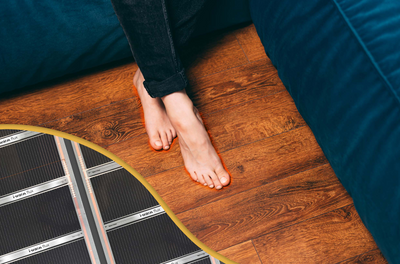
Warm floors for bathrooms, kitchens, extensions and single rooms. Choose an ultra-thin heating film to lay over an existing floor, or a heating mat embedded in a new screed — both controlled by a smart thermostat.

Free Bespoke Underfloor Heating Design

Retrofit and new-build options
Lay over an existing floor or embed in a new screed.
Smart thermostat control
Set schedules and adjust the heating from your phone.
5-year manufacturer warranty
Covers the heating film when installed to the instructions.
Trade accounts available
Register online to open a trade account with us.Which system do I need?
It depends on whether you’re heating an existing floor or laying a new one.
-
 Retrofit
Over an existing floor
An ultra-thin heating film laid on foam underlay or insulation board, beneath laminate, SPC click flooring, engineered wood or heat-resistant carpet. No screed needed.
- Floor finishes
- Laminate, SPC click, engineered wood, heat-resistant carpet
- Adds
- About 4–11mm under the floor finish
- Not suitable for
- Bathrooms and wet rooms
-
 New build
In a new screed
A sealed heating mat embedded in screed during construction, for tiles, natural stone and LVT. Suitable for kitchens and bathrooms.
- Floor finishes
- Tiles, natural stone, LVT
- Laid in
- 35–50mm of screed on insulation board
- Suitable for
- Kitchens, bathrooms, high-traffic areas
Electric or water underfloor heating?
Electric is quicker and cheaper to install. Water costs less to run across larger areas, especially with a heat pump.
| Electric | Water | |
|---|---|---|
| Best for | Single rooms, bathrooms, kitchens and extensions | Whole floors, new builds and larger extensions |
| Heat source | Mains electricity | Boiler or heat pump |
| Installation | Heating film or mat; final connection by a qualified electrician | Pipework and a manifold connected to your heating system |
| Upfront cost | Typically lower: no pipework or manifold | Typically higher |
| Running cost | Higher per unit of heat than gas or a heat pump | Lower, especially with a heat pump |
| Works with a heat pump | No | Yes, and ideally suited to one |

How it heats
Warmth from the floor up
This thermal image shows heat spread across the whole floor, not gathered around a radiator. The floor sensor holds the surface at a comfortable temperature: most floor finishes are set to no more than 27°C.
Because the heating sits under the floor, there are no radiators taking up wall space.
What you need for a complete system
Every installation needs these four things.
-
Heating film or mat
- Sized to the area you want to heat, not the whole room
- Keep at least 5cm from walls
- Not under fixed furniture without legs, such as fridges
-
Connections
- Flux: connectors and sealing tape included
- Core: pre-wired lengths join with a Core main cable
- Core main cables have 2–5 connectors, up to 3,300W
-
Thermostat with floor sensor
- Required for every installation
- A 16A thermostat runs up to about 2,940W
- That’s roughly 13m² of Flux
- Larger areas need a second thermostat or a contactor
-
Floor preparation and connection
- Vapour barrier and insulation board
- Core also needs mesh and screed
- Available from flooring or building suppliers
- On its own circuit with RCD protection
Running costs
To work out the cost per hour, multiply the system’s power in kW by your electricity unit rate.
Calculated at 26.32p per kWh, the Ofgem price cap for 1 October to 31 December 2026.

| Kit | Size | Power | Maximum cost per hour |
|---|---|---|---|
| Flux | 2m² | 440W | 11.6p |
| Flux | 4m² | 880W | 23.2p |
| Flux | 6m² | 1,320W | 34.7p |
| Flux | 8m² | 1,760W | 46.3p |
| Core | 1 linear metre | 128W | 3.4p |
| Core | 2 linear metres | 256W | 6.7p |
| Core | 3 linear metres | 384W | 10.1p |
These are maximum figures with the heating at full output. Once the room reaches temperature, the thermostat switches the heating on and off to hold it, so real running costs are lower and depend on insulation, room size and how long the heating runs.
Shop the range

E000087
i-warm Core Underfloor Heating Kit 1LM
£31.35
excl. VAT
£37.62inc. VAT
E000081
i-warm Core Underfloor Heating Kit 2LM
£62.70
excl. VAT
£75.24inc. VAT
E000078
i-warm Core Underfloor Heating Kit 3LM
£94.06
excl. VAT
£112.87inc. VAT

E000092
i-warm Omni Main Cable (3m) With Easy Connector
£10.40
excl. VAT
£12.48inc. VAT
E000080
i-warm Flux Underfloor Heating Kit 2m2
£88.11
excl. VAT
£105.73inc. VAT
E000073
i-warm Flux Underfloor Heating Kit 4m2
£176.22
excl. VAT
£211.46inc. VAT
E000071
i-warm Flux Underfloor Heating Kit 6m2
£264.33
excl. VAT
£317.20inc. VAT
E000070
i-warm Flux Underfloor Heating Kit 8m2
£352.44
excl. VAT
£422.93inc. VAT

E000086
i-warm Smart Thermostat 16a White
£44.55
excl. VAT
£53.46inc. VAT

E000082
i-warm omni 150W infrared wall & ceiling heating 78x78cm
£61.08
excl. VAT
£73.30inc. VAT
Electric underfloor heating FAQs
How much does electric underfloor heating cost to run?
Is underfloor heating cheaper than radiators?
It depends what heats the radiators. Electric underfloor heating costs about the same per unit of heat as other direct electric heaters. Radiators run from a gas boiler or heat pump usually cost less to run, because gas is cheaper per kWh and a heat pump produces several units of heat for each unit of electricity. For whole-house heating with a heat pump, water underfloor heating is usually the better choice.
Should I choose electric or water underfloor heating?
Electric suits single rooms, bathrooms, kitchens and extensions. Water suits whole floors and new builds, especially alongside a heat pump.
Can I install electric underfloor heating myself?
You can lay the heating film or mat yourself if you’re confident. The final electrical connection must be made by a qualified electrician, on a dedicated circuit with a Type B breaker and RCD protection. The manufacturer’s warranty also requires the installer to record resistance readings and an installation sketch.
Which floor finishes can go over it?
The retrofit film works under laminate at least 6mm thick, SPC click flooring without built-in underlay (at least 6mm), engineered or multi-layer boards at least 10mm thick laid on insulation board, and heat-resistant carpet. The in-screed system works under tiles, natural stone and LVT. Always check your flooring manufacturer’s maximum temperature; many recommend 27°C.
Can I use electric underfloor heating in a bathroom?
Yes, with the in-screed system, as long as the floor won’t be submerged. The retrofit film must not be used under floating floors in bathrooms or wet rooms.
How much floor area can one thermostat control?
A 16A thermostat should run no more than about 2,940W, roughly 13m² of film at 220W/m².
Will it raise my floor height?
The retrofit film adds roughly 4–11mm below the floor finish. The in-screed system sits within 35–50mm of screed, so it’s designed for new floors.
Can it be the main heat source for a room?
It can in a well-insulated room, but that depends on the room’s heat loss. Speak to your local branch before choosing a size.
What warranty comes with it?
The manufacturer provides a 5-year warranty on the heating film, with proof of purchase, the warranty card, an installation sketch and the recorded resistance readings.
Support
Tailored support at every stage of your project
From initial consultation to final installation, Oceanair offer bespoke support to ensure your heating and cooling project is a success, every time.